
Fundamental Principles of Architectural Design in summary
The Fundamental Principles of Architectural Design with Visual Design Elements are explained below:
- Aesthetic:- Aesthetic consider mainly form, beauty, visual impact and build environment. Curvilinear or rectangular, or linear form.
Below, we discuss the seven integral components used in the architectural creation of a design:
- Line:-
- Vertical: Represents dignity, formality, stability, and strength
- Horizontal: Represents calm, peace, and relaxation
- Diagonal: Represents action, activity, excitement, and movement
- Curved: Represents freedom, the natural, having the appearance of softness, and creates a soothing feeling or mood
- Colour:- Warm Colors Reds, oranges, yellows; Cool Colours: Blues, purples, greens
- Space:- Open, uncluttered spaces; cramped, busy spaces
- Form & Form: (3D) The shape and structure of something as different from its
- Shape:- Unused vs. good use of space. Shape: (2D) The two-dimensional contour that characterizes an object or area.
- Texture:-
Smooth Surface: Reflects more light and appears more intense in color.
Rough Surface: Absorbs more light and appears darker
New for you: Architectural Considerations When Designing A Home Security Vault
- Value: Tints and Tones
- Function: usefulness, pleasing, utility, functional value, comfort, ease, surrounding environment
- Social need,
- Livelihood support/requirements
- Spatial feeling,
- Human dimension,
- Private and public space: degree of privacy
- Inclusive: disabled, child, elder, women-friendly
- Structure:-
- Firmness, durability, material, resilient Technology Trabeted system (post and beam, frame structure)
- Load-bearing structure
- Hybrid or SRC, compression/ share structure
- Composite structure, confined masonry
- Arch structures, jack arch, rib/ waffle slab
- Truss/Steel structures/ light gauge structure
- Suspension, Ferri Otto- tensile/cable/ fiber lightweight structure
Visual Design Principles
Seven principles encompass an interesting design.
a) Unity
Unity is the integration of all elements to create a sense of harmony and completeness within a design. It gives a sense of completeness. A balance between unity and variety is essential to avoid a design that is either chaotic or lifeless.
There must be a balance between unity and variety to avoid a chaotic or lifeless design.
b) Balance
Balance is a state where the design elements are equally distributed, creating a sense of stability and equilibrium.
This can be both physical and visual.
Types of Balance:-
• Symmetrical or formal balance: The Taj Mahal, Agra, India
• Asymmetrical or informal balance: Château de Chaumont, Saône-et-Loire, France
• Radial balance: Dresden Frauenkirche Dresden, Germany
• Vertical balance
• Horizontal balance: Chí Lĩn Buddhist Temple and Nunnery Kowloon City, Hong Kong
c) Contrast
Contrast is the combination of opposing elements, e.g., opposite colors on the color wheel – blue /orange, contrast in tone or value-light /dark, contrast in direction horizontal/vertical.
d) Scale or Proportion
Using the relative size of elements against each other can attract attention to a focal point. When elements are designed larger than life, scale is being used to show drama.
Comparative relationships between elements in a design with respect to size 3:5 ratio are known as the Golden Mean.
e) Rhythm and repetition
When one or more elements of design are used to create organized movement, it creates a feeling or a rhythmic pattern. Repetition is the use of similar patterns to make the focal point clearly visible.
Types of Rhythm
- Regular rhythm
- Graduated rhythm
- Random rhythm
- Gradated rhythm
f) Dominance/ Emphasis
Dominance is designed with contrasting size, positioning, color, style, or shape. The focal point should dominate the design with scale and contrast without missing the unity of the whole and their value.
The feature in a design that attracts one’s eye – the focal point
- Emphasis can be achieved through size, placement, shape, color, and/or use of lines
g) Hierarchy
It is the key value in design which provide the arrangement of elements in different order as like the most important to the least.
Factors to be considered while designing buildings
a) Function
The purpose of the building greatly influences design. For example, an auditorium requires open and wide space to accommodate hundreds of audience members and should have large entry and exit gates.
b ) Aesthetics
Buildings that need to attract people, like multiplexes, shopping complexes, restaurants, and resorts, should have eye-
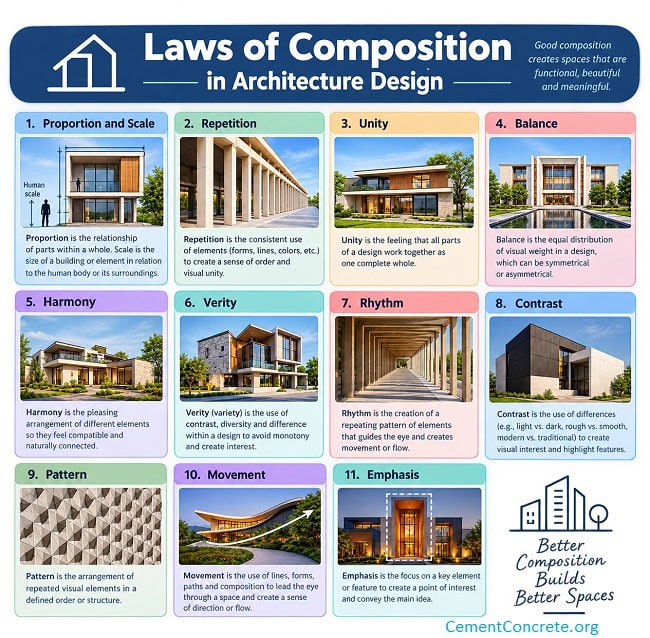
Laws of composition:
- Proportion and scale
- Repetition
- Unity
- Balance
- Harmony
- Verity
- Rhythm
- Contrast
- Pattern
- Movement
- Emphasis
You’ll also Like:
- Architectural Considerations When Designing A Home Security Vault
- Small Two-storey House Plans, Include an Interesting Proposal with a Bookcase in the Interior Design
- What is Employee(Workforce) Wellbeing and Why Does it Matter?
- Laws of composition in Architectural Design:
- Architectural Considerations When Designing A Home Security Vault
- https://cementconcrete.org/construction/employee-workforce-wellbeing/4130/
- What Is Khasra And What Is Khasra Number?
- Architectural Considerations When Designing A Home Security Vault
- Small Two-storey House Plans, Include an Interesting Proposal with a Bookcase in the Interior Design
- What is Employee (Workforce) Wellbeing and Why Does it Matter?


